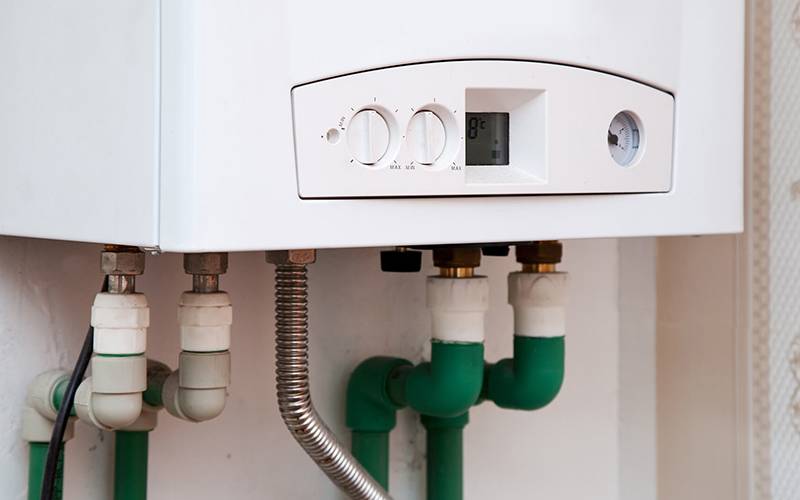
Quick Answer: Tank water heaters cost less upfront and work well for smaller households with predictable hot water needs. Tankless units cost more to install but can last longer, reduce standby energy loss by heating water on demand, and provide continuous hot water when sized correctly. For Asheville homes with hard water, both types require annual maintenance, but tankless units are more sensitive to scale buildup without it. The right choice depends on your household size, hot water usage patterns, available space, and budget timeline.
How Tank Water Heaters Work
A traditional tank water heater stores 40 to 80 gallons of water in an insulated tank and keeps it heated continuously so hot water is available whenever you turn on a faucet. The burner (gas) or heating elements (electric) cycle on and off throughout the day to maintain the set temperature, even when nobody is using water.
This constant heating is called standby energy loss, and it accounts for a meaningful portion of your monthly energy bill. ENERGY STAR notes that water heaters use about 12 percent of a home’s energy, so efficiency and maintenance choices can make a noticeable difference over time.
Tank heaters are reliable and affordable to install. But they have a finite supply. Once the stored hot water runs out, you wait for the tank to recover, which can take 30 to 60 minutes depending on the unit size and fuel type.
How Tankless Water Heaters Work
A tankless (on-demand) water heater does not store water. When you turn on a hot water tap, cold water flows through the unit, a sensor activates the burner or element, and the water is heated instantly as it passes through. When you turn the tap off, the unit shuts down.
This means there’s no standby energy loss because the system only uses energy when hot water is actively needed. It also means you never run out of hot water because there’s no tank to deplete.
The tradeoff is that tankless units have a maximum flow rate. If you’re running the shower, the dishwasher, and the washing machine all at once, a single tankless unit may not keep up with the simultaneous demand. Sizing the unit correctly to your home’s peak demand is critical.
Cost Comparison for Asheville Homes
The upfront cost difference is real. A standard tank water heater (installed) typically costs significantly less than a tankless installation. Tankless units require more complex venting for gas models and often need electrical upgrades for electric models, which adds to the installation cost.
However, the long-term math shifts. Tank water heaters last 8 to 12 years on average. Tankless units last 15 to 20 years with proper maintenance. That means you’ll likely replace a tank heater twice in the same period a single tankless unit serves your home.
Because tankless systems heat water only when needed, the total cost of ownership over 20 years can favor tankless for households that use moderate to high volumes of hot water. ENERGY STAR notes that certified gas tankless models can save on gas bills compared with standard storage models when they are selected and maintained correctly.
How Asheville’s Hard Water Affects Both Types
Asheville’s water hardness of around 8 grains per gallon impacts both types of water heaters, but in different ways.
In a tank heater, mineral sediment settles to the bottom of the tank and insulates the burner or element from the water. This forces the unit to work harder, increases energy use, and shortens the tank’s lifespan. Annual flushing removes the sediment and restores efficiency. Skipping this maintenance is one of the top reasons Asheville homeowners see early water heater failure.
In a tankless heater, scale builds up inside the heat exchanger, which reduces flow and heating efficiency. Annual descaling (flushing with vinegar solution) keeps the heat exchanger clean. Skipping this maintenance on a tankless unit in Asheville’s hard water can void the manufacturer’s warranty and cause costly component failures.
For either type, a whole-home water filtration or softening system reduces the maintenance burden and extends equipment life significantly.
Performance Comparison
Recovery time: Tank heaters need 30 to 60 minutes to recover after the stored supply is used. Tankless heaters provide continuous hot water with no recovery period.
Simultaneous demand: Tank heaters deliver stored hot water to multiple fixtures at once until the tank empties. Tankless units are limited by flow rate and may struggle with very high simultaneous demand unless properly sized or supplemented with a second unit.
Space: Tank heaters occupy significant floor space (roughly 2 by 2 feet for a standard 50-gallon unit). Tankless units mount on a wall and free up that floor area, which matters in smaller Asheville homes and condos.
Cold-weather performance: In Asheville’s winter months, incoming water temperatures drop, which means both types work harder. Tankless units are especially affected because colder incoming water requires more energy to reach the set temperature, which can reduce the effective flow rate during the coldest weeks of the year.
Which One Is Right for You
Choose a tank water heater if your household has low to moderate hot water demand, your budget prioritizes lower upfront cost, you prefer a simpler system with straightforward maintenance, or you’re replacing an existing tank unit and don’t want to reconfigure gas lines or electrical.
Choose a tankless water heater if your household is tired of running out of hot water, you want lower long-term energy costs, you value space savings, you plan to stay in the home long enough to benefit from the longer lifespan, or you’re building new or doing a major bathroom remodel where installation costs can be built into the project.
Let Us Help You Choose
Sudo Plumbing, LLC installs and services both tank and tankless water heaters across Asheville, Weaverville, Arden, Leicester, Candler, Swannanoa, Black Mountain, Woodfin, and Fairview. We assess your household needs, explain both options clearly, and provide flat-rate pricing so you can make an informed decision.
Call Sudo Plumbing, LLC: (828) 676-8772
FAQs About Tankless vs. Tank Water Heaters
How long does a tankless water heater last compared to a tank?
Tank water heaters typically last 8 to 12 years. Tankless units last 15 to 20 years with proper maintenance. In Asheville, where hard water accelerates wear on both types, annual maintenance is essential to reaching those lifespans.
Do tankless water heaters work well in cold climates like Asheville?
Yes, but cold incoming water temperatures in winter reduce the effective flow rate because the unit works harder to heat colder water. Proper sizing accounts for this. A unit that performs well in August may deliver slightly less flow in January if not sized with cold-weather demand in mind.
Can I switch from a tank water heater to tankless?
Yes. The conversion requires upgrading the gas line (for gas tankless) or electrical panel (for electric tankless) and installing proper venting. A licensed Asheville plumber can evaluate your home’s infrastructure and provide an accurate quote for the conversion.
Is a tankless water heater worth the higher upfront cost?
For households that use 41 gallons or less per day, the DOE reports up to 34 percent energy savings. Over a 15- to 20-year lifespan, those savings plus avoiding a second tank replacement often make tankless the better financial decision.