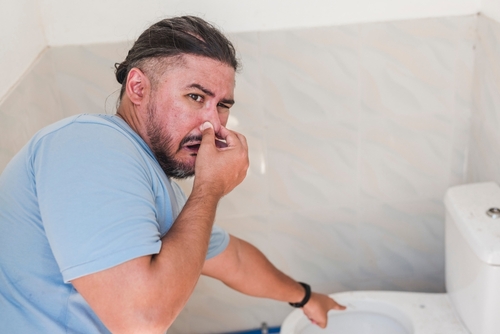
Few things grab your attention faster than the smell of sewer gas inside your house. It’s unpleasant, it’s alarming, and in some cases it can indicate a health and safety concern if hydrogen sulfide and methane gases are accumulating in enclosed spaces.
The good news is that most sewer smell issues in Asheville homes have identifiable causes and straightforward fixes. Here’s where to look and what each one means.
Dry P-Traps
Every drain in your home has a P-trap, that U-shaped bend in the pipe beneath the sink, shower, or floor drain. The trap holds a small amount of water that acts as a seal against sewer gas rising back through the drain.
When a drain goes unused for a few weeks, the water in that trap can evaporate, breaking the seal and letting odor into the house. This is extremely common in guest bathrooms, basement floor drains, and laundry room sinks.
The fix is simple: run water in every drain for about 30 seconds every couple of weeks. If the smell goes away after running water, you found the source.
Damaged or Failed Wax Ring
If the sewer smell is concentrated in or around a bathroom, the wax ring that seals the base of your toilet to the floor flange may have failed. Wax rings can dry out, crack, or shift if the toilet rocks even slightly. Once the seal breaks, sewer gas escapes from the gap between the toilet and the drain pipe.
Replacing a wax ring is a routine repair for any licensed Asheville plumber. If your toilet has any wobble at all, that’s a sign the ring may already be compromised.
Cracked or Damaged Sewer Line
A more serious cause of sewer smell is a crack or break in the sewer line itself, either under the house or in the yard. Damaged sewer lines can leak gas through the soil and into crawl spaces, basements, or through foundation cracks.
Homes in Asheville, Weaverville, and Black Mountain with older clay sewer pipes are particularly susceptible because those materials deteriorate over decades. If you’ve checked every P-trap and wax ring and the smell persists, a sewer line camera inspection is the next step.
If the inspection reveals a failing line, understanding the difference between sewer line repair and full replacement will help you make the right decision without overspending.
Blocked or Inadequate Vent Pipe
Your plumbing system relies on vent pipes that run through the roof to equalize pressure and allow sewer gas to exit safely above the roofline. If a vent pipe is blocked by leaves, debris, bird nests, or ice, that gas has nowhere to go except back through your drains.
Vent blockages often produce a gurgling sound when you run water, in addition to the smell. This is a telltale sign that air isn’t flowing properly through the system.
Biofilm Buildup in Drains
Sometimes the smell isn’t true sewer gas but rather bacteria growing inside the drain pipe itself. Biofilm, a slimy bacterial layer that feeds on soap, grease, and organic matter, produces a sulfur-like odor that’s easy to confuse with sewer gas.
This is common in kitchen drains, shower drains, and garbage disposals. Regular professional drain cleaning removes biofilm that household cleaners can’t reach.
When to Call a Plumber
If running water in all drains doesn’t resolve the smell within a day, or if the odor is strong and persistent, call a licensed plumber. Prolonged exposure to sewer gas isn’t just unpleasant. The EPA notes that hydrogen sulfide, even at low concentrations, can cause headaches, nausea, and irritation, particularly in homes with poor ventilation.
Don’t mask the odor with air fresheners. Find the source.
Let Sudo Plumbing Find the Source
Sudo Plumbing, LLC helps Asheville homeowners identify and eliminate sewer odor problems with camera inspections, drain cleaning, and honest diagnostics. We serve Asheville, Weaverville, Arden, Leicester, Candler, Swannanoa, Black Mountain, Woodfin, and Fairview.
Call Sudo Plumbing, LLC: (828) 676-8772